Introduction
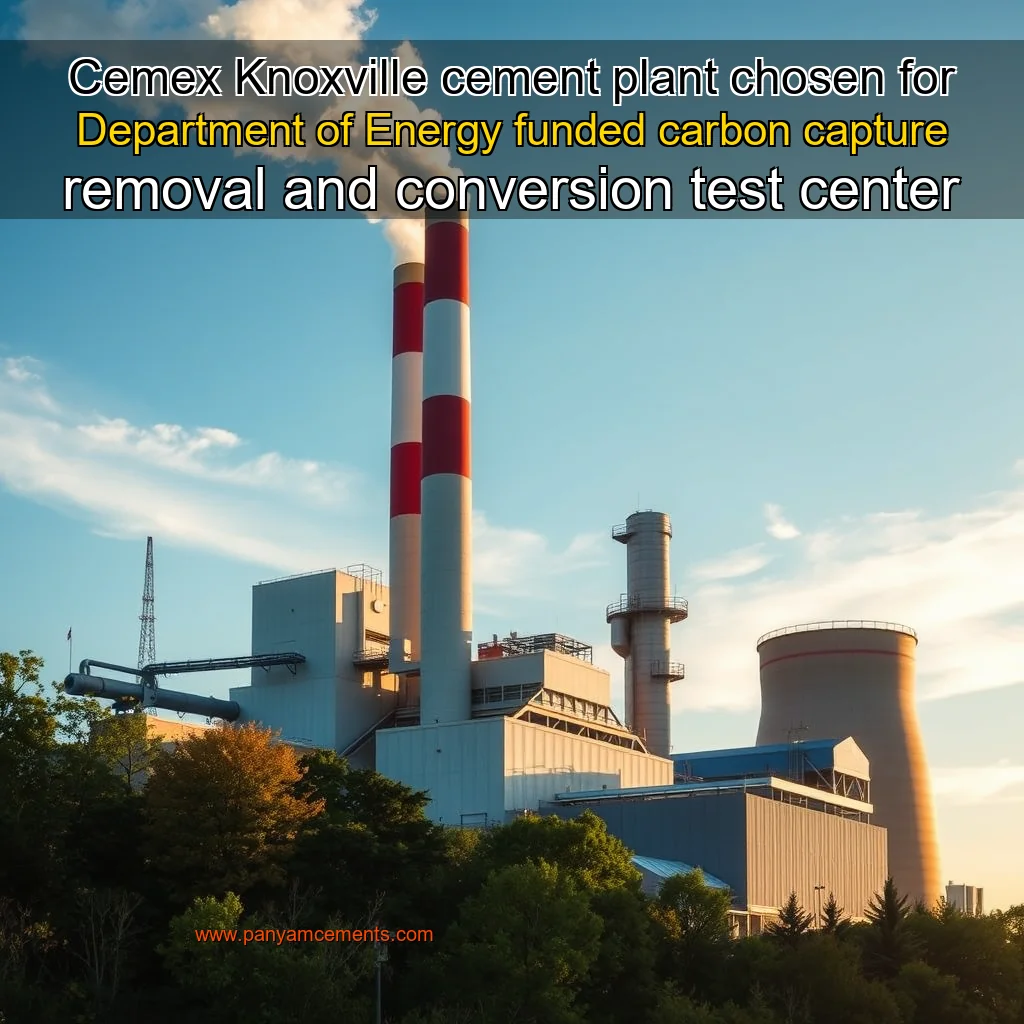
The Department of Energy (DOE) has announced the selection of five cement plants across the United States to participate in a groundbreaking project aimed at reducing greenhouse gas emissions from the cement industry. The project, which is funded by the DOE, will focus on developing and testing carbon capture, removal, and conversion technologies to minimize the environmental impact of cement production. At the center of this initiative is the Cemex Knoxville cement plant in Tennessee, which has been chosen to host a test center for this innovative project.
The Cement Industry’s Environmental Impact
The cement industry is one of the largest contributors to greenhouse gas emissions, accounting for around 8% of global emissions. The production process involves the calcination of limestone, which releases large amounts of carbon dioxide into the atmosphere. Furthermore, the transportation of cement from quarries to manufacturing facilities also contributes to emissions. The need for sustainable and environmentally friendly cement production has become increasingly pressing, prompting the DOE to launch this ambitious project.
The DOE’s Carbon Capture, Removal, and Conversion Test Center
The DOE’s test center will focus on developing and testing technologies that can capture, remove, and convert CO2 emissions from cement production.
Cement Industry Faces Decarbonization Challenge to Mitigate Climate Change and Economic Impacts.
The Cement Industry’s Decarbonization Challenge
The cement industry is one of the largest contributors to greenhouse gas emissions, accounting for around 8% of global emissions. The industry’s carbon footprint is largely due to the calcination process, which involves heating limestone to produce cement. This process releases large amounts of CO2 into the atmosphere, making it a significant contributor to climate change.
The Need for Decarbonization
The cement industry’s carbon footprint is not only a concern for the environment, but also for the economic and social implications. Rising temperatures and extreme weather events are already affecting global food production, water scarcity, and human migration. The cement industry’s carbon emissions are exacerbating these issues, making it essential to develop and implement decarbonization technologies.
The Test Center: A Platform for Innovation
The proposed test center will provide a platform for researchers and industry experts to collaborate and develop advanced systems for decarbonizing the cement industry. The test center will be designed to simulate real-world conditions, allowing for the testing and evaluation of various technologies and systems.
Key Features of the Test Center
Collaboration and Development
Cemex and a coalition of U.S. cement producers will develop the conceptual design, business, technical, and managerial structures for the test center.
Introduction
The Net-Zero Center of Excellence is a leading research and development facility dedicated to advancing the field of net-zero energy systems. Located at the University of Illinois at Urbana-Champaign, this center is part of the Prairie Research Institute and plays a crucial role in driving innovation and sustainability in the built environment.
Key Features and Focus Areas
The Net-Zero Center of Excellence is equipped with state-of-the-art facilities and cutting-edge technologies, allowing researchers to conduct comprehensive studies and experiments.
Reducing carbon emissions from cement production is a crucial step towards mitigating climate change.
The goal of CCUS is to achieve a reduction of 5-7% in emissions per year. This is a major step towards decarbonization of the cement industry, which is one of the most carbon-intensive industries globally. The cement industry is responsible for around 8% of global CO2 emissions. By reducing emissions from the cement industry, we can make a significant impact on mitigating climate change. Cemex has already made significant progress in reducing its carbon footprint, with a 44% reduction in emissions since 2010. However, the goal of achieving net-zero emissions by 2050 is ambitious and requires continued efforts to reduce emissions. CCUS is an essential component of this roadmap and will play a crucial role in achieving Cemex’s sustainability goals. The CCUS technology is designed to capture CO2 from biogenic sources such as cement production, where the process is carbon-neutral. The captured CO2 is then utilized or stored, reducing the amount of CO2 released into the atmosphere. This technology has the potential to significantly reduce emissions from the cement industry, making it a vital component of the roadmap for Future in Action. Furthermore, the use of CCUS technology can also support the development of new low-carbon cement production processes. By capturing and utilizing CO2, the cement industry can reduce its reliance on fossil fuels and lower its carbon footprint.
History of the University
The University of Illinois at Urbana-Champaign has a rich and storied history that spans over 150 years. Founded in 1867, the university was established by the Illinois General Assembly as a land-grant institution, with the primary goal of providing education to the people of Illinois. The university’s early years were marked by a focus on agriculture, engineering, and the arts, with the first classes held in 1870.
Early Years and Expansion
The Rise of Open-Source Security Solutions
In recent years, the security industry has witnessed a significant shift towards open-source solutions. This trend is driven by the growing need for more transparent and community-driven security tools. As a result, several security companies have come together to launch Opengrep, a collaborative fork of Semgrep’s code analysis engine.
What is Opengrep? Opengrep is an open-source security solution that aims to provide a more comprehensive and community-driven approach to code analysis. By leveraging the collective expertise of multiple security companies, Opengrep seeks to address the limitations of traditional security tools.
iBwave Unity Cloud: Revolutionizing Wireless Design and Planning
The iBwave Unity cloud-based solution is designed to provide users with a more efficient, flexible, and cost-effective way to design and plan wireless networks. With the launch of the cloud-based version, iBwave Solutions aims to further enhance the capabilities of its popular Unity platform, making it more accessible to a wider range of users.
Key Features of iBwave Unity Cloud
News published on 20 january 2025 at 07:39 and distributed by:

news is a contributor at PanyamCements. We are committed to providing well-researched, accurate, and valuable content to our readers.